Kathy Rose’s works seemed to have a lot of tribal or spiritual qualities to it. I would describe her work as being performance, mixed with animation, and sound design. What interested me the most about her work was the involvement of sound and the cultural influences that were evident in her work. She said that she was influenced by Japanese artists. Kathy said “Just going into a drug store in Tokyo can change your life around because the designs and art are very different.” Having been recently in Germany, I instantly related to this. I probably photographed many things I wouldn’t have cared to photograph back in the United States. Everything seemed new and exciting and really made me want to expand my work through exposure to other countries. In relation to her creation process, Kathy had said that every part of a piece tends to be built up together. She doesn’t necessarily start with a score and make a piece, or have a full choreographed dance ahead of time, or the animation finished. Each element is mixed with the others until it all comes together in one coherent final project. I can’t say that any one piece really jumped out at me as being my favorite, but one piece made me think of a question which went unanswered. In one of her reels there was a sound clip that repetitively said six, six, six. I immediately began to wonder what her intent was in provoking an anti-religious demonic notation such as this. I thought that a lot of the sound design was rather dark and wasn’t too shocked by this, but more surprised by the fact that no one asked about it.
1. You seem to work in many mediums which is your favorite?
The many mediums that appear on her website now make sense to me. There aren’t many mediums. It’s just a way of displaying her compiled pieces in video or still format. Her work is a combination of animation, sound, and performance.
2. What new projects do you have working?
She didn’t really say exactly what she was doing next but commented that one project always leads to the next. So that the new project in one way shape or form will be related to the previous.
Thursday, March 3, 2011

Monday, February 28, 2011


Tuesday, February 22, 2011
On the Road.
I've been traveling US40 the last few days on my way to Arizona. Unfortunately the schedule hasn't allowed for many detours but I still have managed to get a few good pictures.
Arkansas -
 New Mexico -

Having arrived in Arizona I was surrounded by palm trees, Joshua trees, and sunlight but where was the heat?! It was fairly cold the whole drive out west. I was honestly not prepared for it to be so cold. Walking around I came across some interesting scenes.

Mainly the one that stuck out really strongly as being odd was this strange box by the side of the road with a balloon attached to it. I wasn't sure if it was someone’s gift of anthrax to me or what, I didn't open the box but it seemed really light when I kicked it to change it's position. I really enjoyed the relationship of the balloon’s color to the color of the sky and it's overall displacement from the typical location you would see such an object.
Another thing that I have started thinking about is really making the frame of the image count. I've been messing around with trying to be more minimalistic.


I think by trying to shoot differently it helps me think about what works or doesn't work for my project. Technique should benefit the image not be the image. I think that a lot of people’s work that I have been looking at recently has a very soft palette of colors. I also wonder a lot if they are shooting film to get their look. I constantly find myself shooting in a method that I think benefits what I am looking at. The following two pictures where taken on the last night of my trip in Phoenix Arizona.


I think both images are equally interesting in their own way. What do you think? Overall I think the trip has really helped me to relax and think more about what I am doing and why I am doing.
Arkansas -


Having arrived in Arizona I was surrounded by palm trees, Joshua trees, and sunlight but where was the heat?! It was fairly cold the whole drive out west. I was honestly not prepared for it to be so cold. Walking around I came across some interesting scenes.

Another thing that I have started thinking about is really making the frame of the image count. I've been messing around with trying to be more minimalistic.


I think both images are equally interesting in their own way. What do you think? Overall I think the trip has really helped me to relax and think more about what I am doing and why I am doing.
Thursday, February 17, 2011
Wednesday, February 16, 2011
Micheal Hall
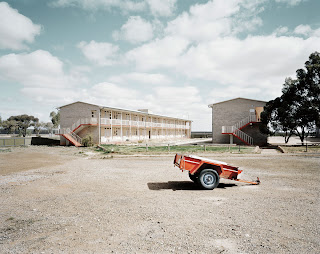
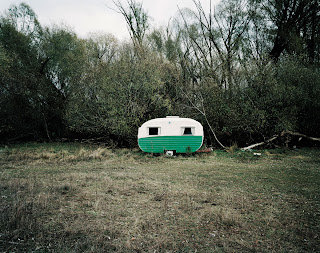
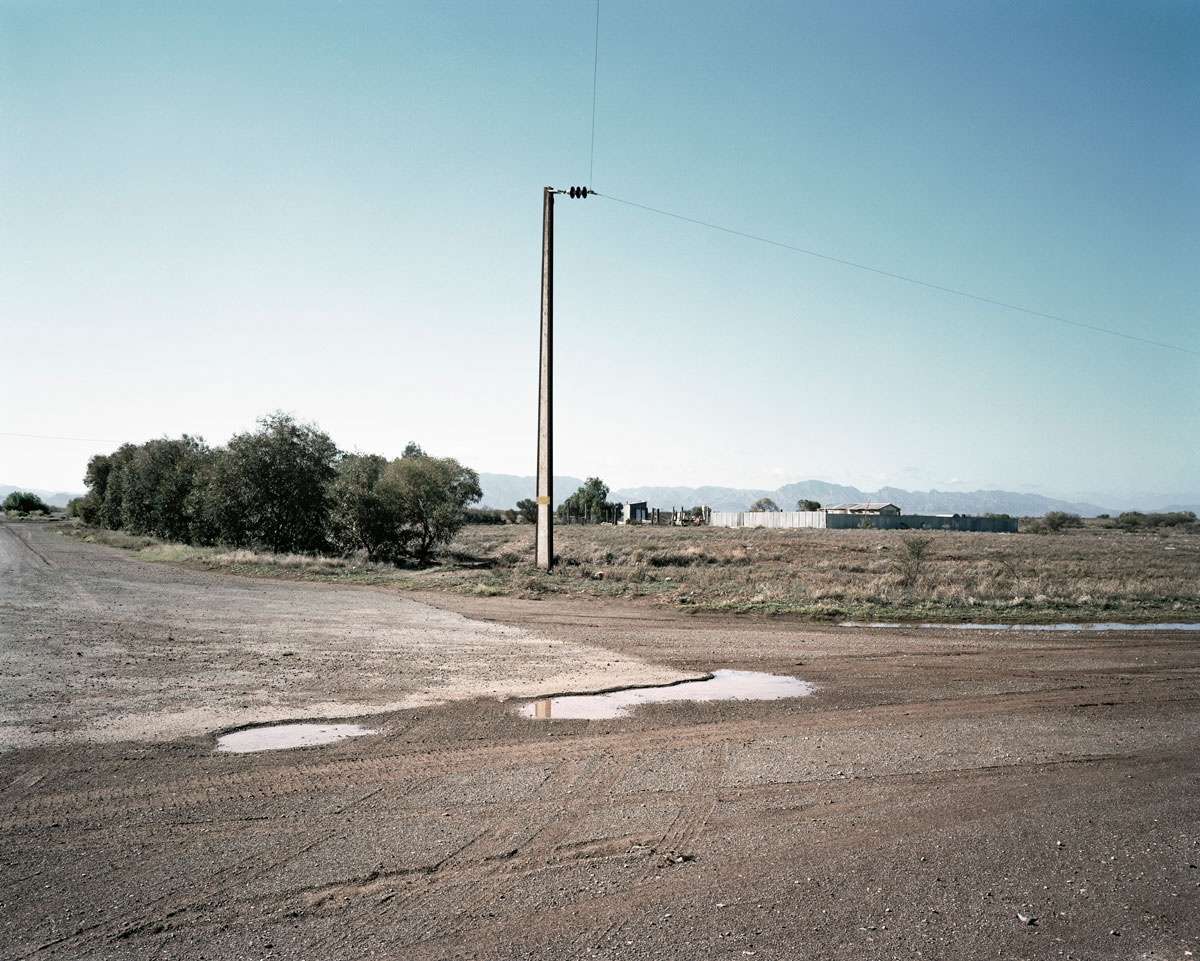
What I enjoy most about Micheal Hall’s work is the attention that he pays to objects that we can relate to his. Landscapes often seem to be related to the ecosystem and the changing of the atmosphere, which could have a profound impact on our life. Much like my project, I think he is trying to draw attention to things that are often over looked by the general public.
Biography - Michael Hall has been a practicing professional photographer for over 20 years. Throughout that time, he has built a considerable reputation in Australia and internationally as both a fine art and commercial photographer. He was selected as Photographer of the Year in 2006 by the Federation of European Photographers, and in 2004 won the Canon New Zealand Architectural Photographer of the Year. More recently, Michael was announced as a finalist in the Hasselblad Masters 2009.
His fine art work focuses specifically on exploring human impact upon the landscape. Michael invests much time and energy in personal photographic projects – projects that engage with compelling and often confronting issues that ultimately affect us all. He is currently undertaking an extensive project to document the causes and effects of climate change to improve ecological awareness around the world.
Hall, Michael . "Michael Hall Photography." Michael Hall Photography. N.p., n.d. Web. 16 Feb. 2011. <http://www.michaelhall.net/>.
Images -


Links -
Artist Website: http://www.michaelhall.net/
Artist Blog: http://michaelhallphotography.wordpress.com/exhibitions/
http://www.sierraclub.org/sierra/201005/china.aspx
http://www.thedailybeast.com/blogs-and-stories/2009-10-13/shocking-climate-change-photos/
http://www.australiaproject.com/michael_hall_gallery.html
http://www.utsgallery.uts.edu.au/gallery/past/2010/challengedlandscape.html
Biography - Michael Hall has been a practicing professional photographer for over 20 years. Throughout that time, he has built a considerable reputation in Australia and internationally as both a fine art and commercial photographer. He was selected as Photographer of the Year in 2006 by the Federation of European Photographers, and in 2004 won the Canon New Zealand Architectural Photographer of the Year. More recently, Michael was announced as a finalist in the Hasselblad Masters 2009.
His fine art work focuses specifically on exploring human impact upon the landscape. Michael invests much time and energy in personal photographic projects – projects that engage with compelling and often confronting issues that ultimately affect us all. He is currently undertaking an extensive project to document the causes and effects of climate change to improve ecological awareness around the world.
Hall, Michael . "Michael Hall Photography." Michael Hall Photography. N.p., n.d. Web. 16 Feb. 2011. <http://www.michaelhall.net/>.
Images -




Links -
Artist Website: http://www.michaelhall.net/
Artist Blog: http://michaelhallphotography.wordpress.com/exhibitions/
http://www.sierraclub.org/sierra/201005/china.aspx
http://www.thedailybeast.com/blogs-and-stories/2009-10-13/shocking-climate-change-photos/
http://www.australiaproject.com/michael_hall_gallery.html
http://www.utsgallery.uts.edu.au/gallery/past/2010/challengedlandscape.html
Thursday, February 10, 2011
The West Coast
As an American photographing the contemporary landscape, I think it is important for me to contemplate the landscape in the traditional sense. When I look at the works of the great master photographer Ansel Adams, I think about what he must have experienced as he first went out west to photograph the landscape. “Born in San Francisco, Ansel Adams was 14 when he made his first trip to the spectacular national park of Yosemite, California. The experience was of such intensity that it stayed with him for the rest of his life. [1]” It’s also interesting to me that Ansel had a period when he said, “At that time we'd all been bitten by the Surrealist bug, and we were finding incongruous juxtapositions everywhere. I was out near Long Beach and drove by a cemetery, and here was this white marble angel of death behind some oil derricks.[2]” I wasn’t even aware of this images by Ansel until reading an interview by Mary Ellen Marks, in which he talked about how it often got used for pollution ads even though that was never his real intention. In the upcoming weeks I hope to be traveling out West towards Arizona to reflect upon the photographs taken by the old masters, as well as to build on my series of images with creative juxtapositions.
Works Cited
[1] "BBC - BBC Four - Audio Interviews - Ansel Adams." BBC - Homepage. N.p., n.d. Web. 13 Feb. 2011. <http://www.bbc.co.uk/bbcfour/audiointerviews/profilepages/adamsa1.shtml>.
[2] Mark, Mary Ellen. "ART NEWS - ANSEL ADAMS-THE LAST INTERVIEW - 905N-000-001." Mary Ellen Mark Home Page. N.p., n.d. Web. 13 Feb. 2011. <http://www.maryellenmark.com/text/magazines/art%20news/905N-000-001.html>.
Works Cited
[1] "BBC - BBC Four - Audio Interviews - Ansel Adams." BBC - Homepage. N.p., n.d. Web. 13 Feb. 2011. <http://www.bbc.co.uk/bbcfour/audiointerviews/profilepages/adamsa1.shtml>.
[2] Mark, Mary Ellen. "ART NEWS - ANSEL ADAMS-THE LAST INTERVIEW - 905N-000-001." Mary Ellen Mark Home Page. N.p., n.d. Web. 13 Feb. 2011. <http://www.maryellenmark.com/text/magazines/art%20news/905N-000-001.html>.
Monday, February 7, 2011
Xu Bing - Lecture
The Xu Bing lecture was very interesting. It was the first lecture which I have attended where there was a translator present. The majority of the lecture was given in Chinese. Having been somewhat involved with Xu Bing tobacco project from the beginning, I was aware of many of the things they were preparing to do and what he would talk about somewhat in the lecture. I wasn’t, however, as familiar with some of the earlier projects. I would consider Xu Bing’s work to be conceptual researched fine art. The majority of his projects involve a lot of people and take much planning and orchestration. The project that I am really drawn to is Book from the Ground. In this series Xu has collected and produced many, many icons with the idea that icons could “treat the reader equally regardless of education and culture.” What informs the readers ability to translate the icons is their cultural experiences. Xu commented that “traditional life no longer exists, but we still use traditional language.” Having gotten back from Germany a few months ago, I realized how difficult it was for me to communicate with my limited knowledge of the language. I think it’s a great idea to try to make a universal language that everyone can understand. As well as making books using this method, Xu Bing created software that would translate from English to icons or from Chinese to icons. If the items that were picked had the same meaning, the icon would be the same. In this way two foreigners were able to communicate without having to learn the traditional language of the other speaker. The idea of practical art or art that has more use than just to be enjoyed is very interesting.
Questions:
1. What's is your primary goal each time you revisit an old project?
I think that repeating projects is rather natural. I find that in my own work I often photograph a scene repetitively with different lighting conditions and different angles. I think it has to do with having a complete understanding in what I engage with. Xu Bing didn’t address this exactly, but I believe his intentions were to do a series of the tobacco projects, and, in doing so, he will explore tobacco as a material.
2. Has tobacco had an impact on your life?
I believe to Xu Bing the Tobacco project is about the cultural influence with the graphics and the commercial packaging that was involved. As far as a real personal impact, I don’t believe that was the case.
Questions:
1. What's is your primary goal each time you revisit an old project?
I think that repeating projects is rather natural. I find that in my own work I often photograph a scene repetitively with different lighting conditions and different angles. I think it has to do with having a complete understanding in what I engage with. Xu Bing didn’t address this exactly, but I believe his intentions were to do a series of the tobacco projects, and, in doing so, he will explore tobacco as a material.
2. Has tobacco had an impact on your life?
I believe to Xu Bing the Tobacco project is about the cultural influence with the graphics and the commercial packaging that was involved. As far as a real personal impact, I don’t believe that was the case.
Subscribe to:
Posts (Atom)